
Most teams use AI as a faster typist. They open a chat window, ask for “a blog post about X” and then spend hours fixing what comes back. That’s why so much AI content reads like everyone else’s — and why it rarely ranks or converts.
The real gain isn’t in drafting. It’s in research, briefing and editing structure. When I rebuilt my own content process around that idea, production time dropped by roughly half, with no drop in ranking performance. Here’s exactly how the pipeline works.
Why “write me a blog post” fails
A one-shot prompt asks the model to make every decision at once: the angle, the structure, the examples, the claims and the voice. It will make those decisions — badly, and in the most average way possible. The result is generic, sometimes wrong, and always in need of a rewrite.
- No search intent: the model doesn’t know what the people searching actually want answered first.
- No point of view: without a human angle, you get a summary of what already ranks.
- Unverified claims: numbers and “facts” that sound right but aren’t.
- Lost voice: your brand ends up sounding like every other AI-assisted site.
The four-stage pipeline
Instead of one big prompt, I split the work into four stages. AI does the heavy lifting in the middle; people own the thinking at both ends.
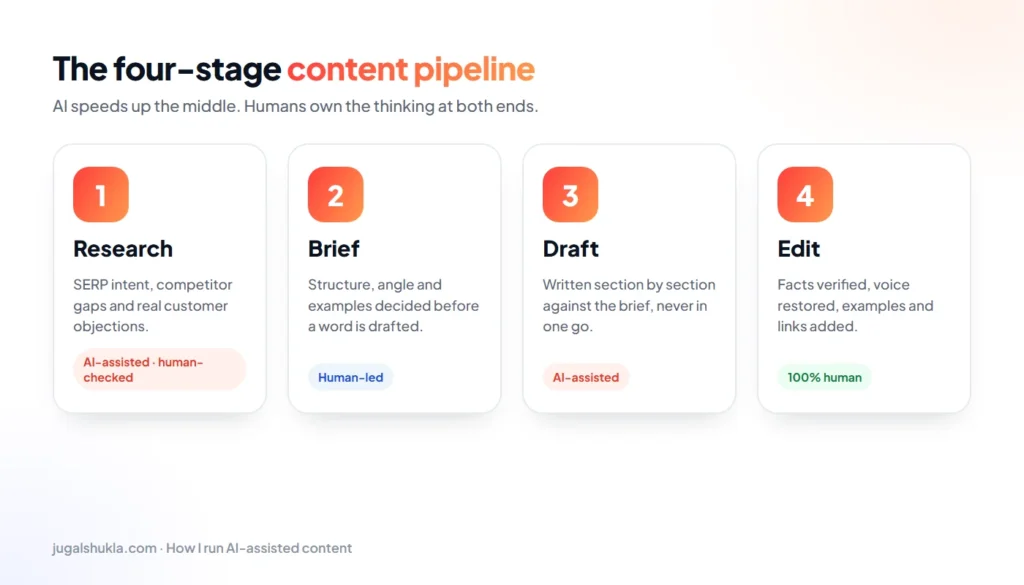
1. Research
Research pulls the search results for the target query, the gaps competitors leave, and real customer objections from sales calls, reviews and support emails. AI is excellent at summarising this quickly — but a person checks that the summary reflects what buyers actually ask.
2. Brief
The brief is where the angle gets decided — by a human. It sets the structure, the questions each section must answer, the examples to use and the internal links to include. A good brief is the single biggest predictor of a good article.
3. Draft
Drafting is AI-assisted, section by section, against the brief — never in one go. Each section is generated with the context it needs, which keeps the output focused and stops the model drifting into filler.
4. Edit
Editing is entirely human. Claims are verified, the brand voice is restored, real examples from client work are added, and anything generic is cut. This is the stage that turns a decent draft into something worth reading.
Where the time actually goes
The saving doesn’t come from typing faster. It comes from removing the slowest, most frustrating parts of writing from scratch — staring at a blank page, restructuring halfway through, and rewriting sections that missed the point.
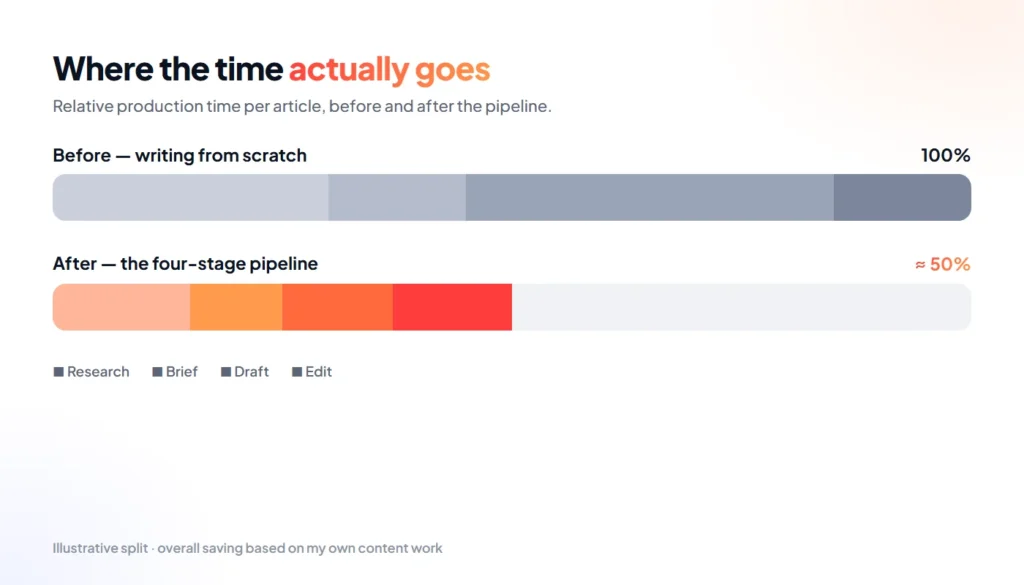
Research and drafting shrink the most. The brief takes about the same time as before — and that’s deliberate. Editing stays fully human, but because the draft already follows a strong brief, there’s far less to fix.
Quality gates before anything is published
Speed is worthless if the output damages trust. Every article passes the same checklist before it goes live — ticked by a person, not a tool.
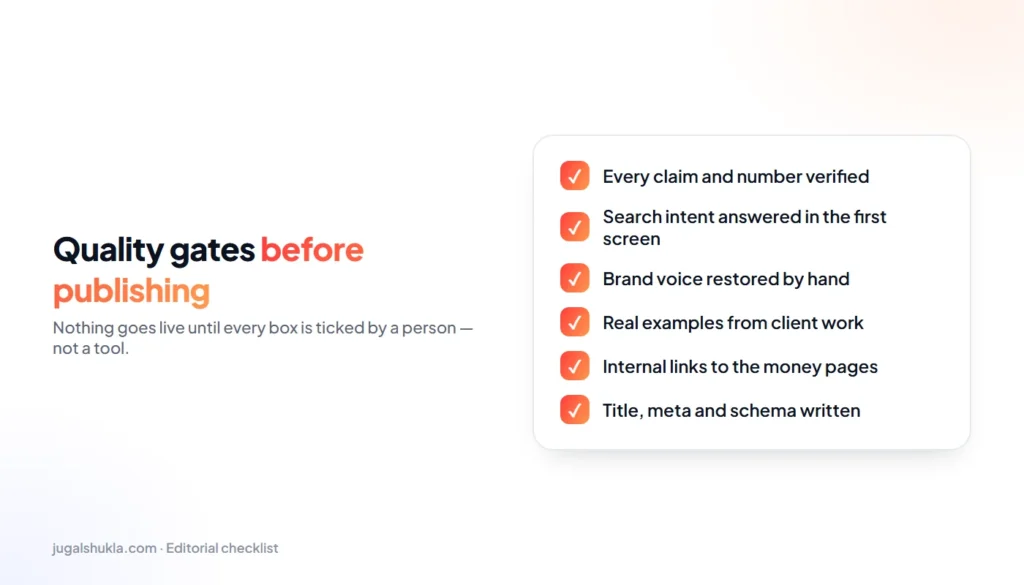
- Every claim and number is verified against a source.
- The search intent is answered in the first screen.
- The brand voice has been restored by hand.
- At least one real example from client work is included.
- Internal links point to the relevant service or money pages.
- Title, meta description and schema are written.
What this means for your team
You don’t need more writers, and you don’t need to hand your content to a chatbot. You need a process that puts AI where it genuinely speeds things up — and keeps humans where judgement matters. The thinking still happens where it always did; you just spend less time on the parts that don’t need you.
If your content calendar keeps slipping, this is usually the fastest fix. I set up the pipeline, the prompt library and the quality gates, then train your team to run it.